 Kinky Thinking
On this page
Pony play is a kind of pet play where one partner takes on the role of a horse or pony, and the other becomes their trainer, owner, handler or rider. Compared with the bouncy, affectionate feel of puppy play, pony play is usually more about discipline, posture, training and being shown off.
What a pony play scene looks like
There’s no single way to do it, but common elements include:
- Training: learning commands, walking or trotting with a high step, holding a proud posture.
- Grooming and care: being brushed, fed, watered and fussed over by the trainer.
- Presentation: being dressed in gear and shown off, sometimes at specialist events.
- Work: pulling a light cart (for experienced players), or carrying the trainer for a short time.
- Discipline: correction with a voice, a touch, or a light riding crop, as agreed.
The pony usually doesn’t speak, and communicates with snorts, stamps and nods instead. That makes agreeing a non-verbal safe signal especially important.
The gear
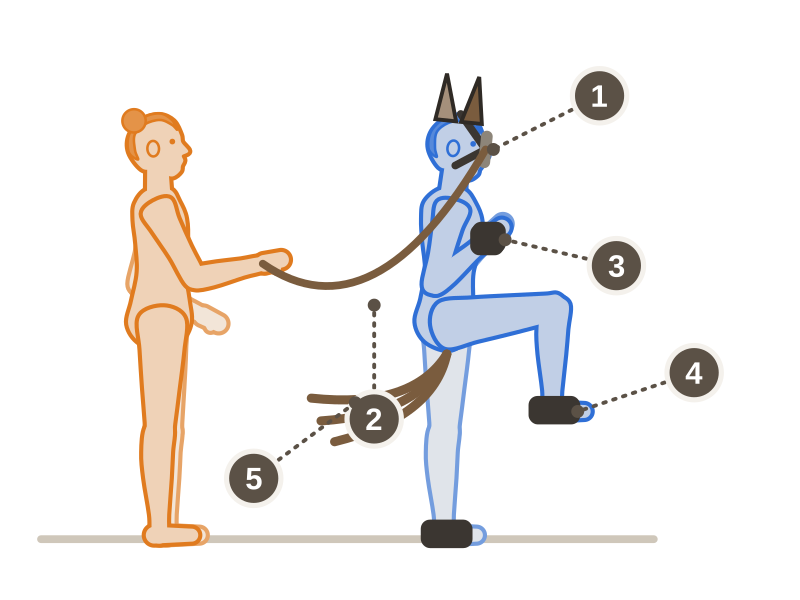
None of this is needed to start, but it’s a big part of the appeal for many:
- Head harness or bridle, sometimes with a bit, a bar held lightly between the teeth.
- Reins attached to the bridle or a body harness.
- Hoof boots and hoof gloves, which change how the pony stands and moves.
- A tail, often attached to a harness or belt.
- Blinkers, which limit side vision.
Why people enjoy it
- Headspace. Letting go of speech and everyday responsibilities to become, for a while, simply a pony.
- Structure. Training, rules and progress appeal to people who enjoy D/s dynamics.
- Pride and display. Being groomed, dressed up and admired.
- For trainers: the care, control and patience of bringing a pony on.
Starting safely
- Talk first. Agree what’s in and out, whether it’s sexual, and a non-verbal safe signal, like stamping three times or dropping something. Our negotiation checklist helps.
- Start without gear. A short scene with simple commands and grooming is enough to find out if you like it.
- Go easy on bodies. Pad any kneeling, avoid riding at first, and take breaks.
- Be careful with bits and blinkers. Bits can make jaws ache and make speech hard; blinkers make it easy to trip. Use them only in a clear space and for short periods.
- Keep it private, at home or at an adult event where everyone has agreed to be there.
Stop if…
- The pony gives the safe signal, or seems distressed rather than in the role.
- There’s pain in the back, knees, wrists or jaw.
- Anyone trips or falls, or the space gets cluttered.
Afterwards
Coming out of a pony headspace can take a moment. Remove gear, offer water and something to eat, talk in your normal voices, and make time for aftercare. If you’re the trainer, our guide to being a handler in pet play covers the role in more depth.
Curious about other animal roles? See kitten play and puppy play, or browse the roleplay section of our list of kinks.
Try it together
Frequently asked questions
What is pony play?
Pony play is a type of pet play where one person takes on the role and mindset of a horse or pony, and another acts as their trainer, handler, owner or rider. Scenes often involve training, grooming, posture, high-stepping, pulling a cart, or being shown off.
Is pony play sexual?
It can be, but it doesn't have to be. For some people it's part of sex; for others it's about discipline, the headspace and the look, with nothing sexual at all. Agree what it means for the two of you.
What gear is used in pony play?
Common gear includes a head harness or bridle, a bit (a bar held between the teeth), reins, a body harness, hoof boots or gloves, a tail, and sometimes blinkers or a cart. None of it is needed to start: a simple scene can work with no gear at all.
What's the difference between pony play and puppy play?
Both are kinds of pet play, but the feel is different. Puppy play is often playful, affectionate and bouncy. Pony play tends to focus more on discipline, training, posture and presentation, with a more formal trainer-and-pony relationship.
Can you ride someone in pony play?
Some people do, but it puts a lot of strain on the back, knees and wrists. It's best skipped at first, and only tried briefly, on soft ground, with a partner who's strong enough and keen to try. Many pony players never do it at all.